Why You Can’t Sleep — And What Finally Fixed It for Me
I never used to get good, restorative sleep. Like, ever.
Wake-ups at 2am. A brain that absolutely refused to shut the fuck up. Anxiety that showed up the second my head hit the pillow. That exhausted-but-wired feeling that makes you want to cry because you’re so tired and yet sleep is nowhere to be found.
For most of my adult life I just accepted that this was how it was. Bad sleep was just… me.
It wasn’t me. It was everything I was doing — and everything the world around me was doing to my nervous system — that was destroying my restorative sleep every single night. And I had no idea.
Now? I sleep well consistently. Deep, restorative, wake-up-feeling-like-a-human sleep. And I know exactly why it works — which means I also know exactly what to do when it doesn’t.
This is what I learned. And trust me, some of it is going to piss you off.
The Thing That Made the Biggest Difference (I Didn’t See It Coming)
When I started cleaning up my habits after that couch photo wake-up call, I stopped drinking alcohol almost completely. I did it because of how I looked and felt overall — I wasn’t even thinking about sleep.
But holy shit, what happened to my sleep!?
The difference was immediate and undeniable. I hadn’t realized how much alcohol was absolutely wrecking my ability to get deep, restorative sleep. It feels like it helps you relax and drift off — and it does, technically. But what it actually does is fragment your sleep architecture all night long. You might fall asleep faster, but you’re trading quality for speed. And in midlife, when your sleep is already fragile from hormone shifts and a chronically stressed nervous system? That trade-off is not fucking worth it.
Now, not drinking at night is non-negotiable for me. Not because someone told me I had to. Because I know what it does to my sleep, and my sleep is more important to me than whatever fun I might have had with a glass of wine. That’s the shift — when you actually understand what’s happening in your body, you stop fighting the rules and start making informed choices. For yourself. Because you want to.
Same goes for eating late at night. Once I understood what late-night eating does to blood sugar — how it spikes, then crashes, then your body releases cortisol to bring it back up, which wakes you the hell up at 2am with a racing heart — I stopped doing it. Not out of discipline. Out of understanding.
Knowledge is the most underrated sleep tool there is.
The World Is Working Against Your Restorative Sleep
Here’s something that really needs to sink in… you are not broken. Your sleep is not broken. Your nervous system is responding exactly the way it’s supposed to respond to an environment that is completely hostile to rest.
We live in a world that is designed — literally engineered — to keep your nervous system activated. Screens that blast blue light and tell your brain it’s noon at 10pm. Social media that floods you with emotionally charged content right before bed. A pace of life that never actually stops. A mental load — especially for midlife women — that includes not just your own life but everyone else’s schedules, emotions, and needs on top of your own.
And then we layer midlife on top of all of that. Fluctuating estrogen and progesterone that mess with melatonin production and body temperature regulation. Cortisol that spikes at the wrong times — staying elevated into the evening instead of dropping, which is why you’re lying awake at 1am feeling wired and exhausted simultaneously. Hot flashes that blow up your sleep architecture multiple times a night. A nervous system that’s been running in fight-or-flight mode for so long it’s forgotten what “safe to rest” even feels like.
Some days I look back at everything that I did, dealt with, prepared for, avoided, took care of, completed, stopped or started and literally the morning feels like it happened 3 days prior (no wonder it’s hard to sleep). This is not normal, desired, or sustainable!
Again, this is not a discipline problem, or a willpower problem. This is biology — and it deserves a biological solution, not another “just try harder” pep talk.
What My Sleep Routine Actually Looks Like (The Real Version)
I’m going to tell you what works for me — the whole truth, not the sanitized wellness version.
The non-negotiables that happen every night:
No alcohol. No eating late. The room as cold as I can possibly get it — temperature is one of the most underrated sleep tools, and your body needs to cool down to properly enter deep sleep. A fan or air conditioner running for white noise. A weighted blanket. A sleep mask.
I’ve tried a lot of sleep tools over the years. These are the ones that work for me and that I now do without thinking because they’ve become part of how I sleep. Your list will be different — and finding your list is part of the process.
The one that can make a big difference: Cannabis. Yes, I use it when I need a little extra help (and sometimes when I don’t). I’ve tried all the things — magnesium, melatonin, ashwagandha, L-theanine, herbal teas, you name it. For me, cannabis works better to put me to sleep, so it’s one of the tools in my toolkit and I’m not going to pretend it isn’t. I know midlife women are using it quietly all over the place… for fucks sake we might as well talk about it like adults!
The imperfect part — and why I’m telling you this:
I watch TV when I get into bed. I know, I know. Blue light, nervous system activation, circadian rhythm disruption — yes, I’m aware of all of it. The workbook covers all of it. But I still do it, because watching TV at the end of the day is literally the only time I get to decompress and step out of my daily routine. I look forward to it, and I’m not giving that up.
Here’s the thing: wellness isn’t about eliminating everything that brings you comfort or joy. It’s about understanding the trade-offs and figuring out how to make it work anyway. I do everything else right — the cold room, the fan, the no alcohol, the no late eating, the weighted blanket, the sleep mask — and it works. Even with the TV. Because I’ve built a system that supports my nervous system enough that one imperfect element doesn’t blow the whole thing up.
That’s what real wellness looks like. Not perfect. Strategic. I mean, how boring would it be if we all followed all these guidelines all the time?
Getting up at the same time every day is also a non-negotiable — weekdays and weekends. My body wakes up at the same time naturally now, and forcing myself to sleep in would actually make me feel worse. That consistent wake time is one of the most powerful anchors for your circadian rhythm, and it makes falling asleep at night significantly easier.
My backup plan for the nights that still don’t work: I have a guided sleep meditation I use when my brain won’t stop running. I have genuinely never finished it. I’m asleep before it ends, every single time. Having a strategy that I know works — something I can reach for on the hard nights instead of lying there panicking about not sleeping — is one of the most comforting things I’ve built into my routine. Because the panic about not sleeping is often worse than the not sleeping itself.
Why Midlife Women Sleep Like Shit (It’s Not Random)
Here’s the part that nobody explains clearly enough.
Your sleep isn’t failing because you’re getting older. It’s failing because several major biological systems are changing at the same time, and they all affect sleep.
Hormones: Estrogen and progesterone directly influence melatonin production, body temperature regulation, and how sensitive your nervous system is to stress. As they fluctuate, your sleep signals become inconsistent. You might feel exhausted at 7pm and completely wired by 10pm. That’s not random. That’s your hormones.
Cortisol gone rogue: You’re supposed to wake up with cortisol high and go to sleep with it low. Chronic stress — the kind every midlife woman is carrying — trains your body to stay alert longer. Instead of cortisol dropping in the evening, it stays elevated, which keeps your nervous system in a state that’s fundamentally incompatible with deep sleep. This is why you wake up at 2am with anxiety you can’t explain. Your cortisol just spiked.
The stress-sleep doom loop: Stress disrupts sleep. Poor sleep increases stress. Increased stress further disrupts sleep. Repeat until your eyebags need their own zip code and you’re Googling “can you die from sleep deprivation” at 4am. You cannot think your way out of this loop. You have to address the nervous system directly in order to get good, restorative sleep.
Emotional labor: Women carry a mental load that men simply don’t experience in the same way. Managing everyone’s schedules, emotions, and needs — on top of your own — keeps your brain activated all day. And bedtime is often the first quiet moment you’ve had, which means your brain treats it as an opportunity to process everything it didn’t have time to process during the day. Your head hits the pillow and suddenly it’s a full-length feature film of every conversation you’ve had since 1998.
This is physiology. And anyone who tells you to “just relax” has clearly never experienced the midlife hormone shitstorm firsthand.
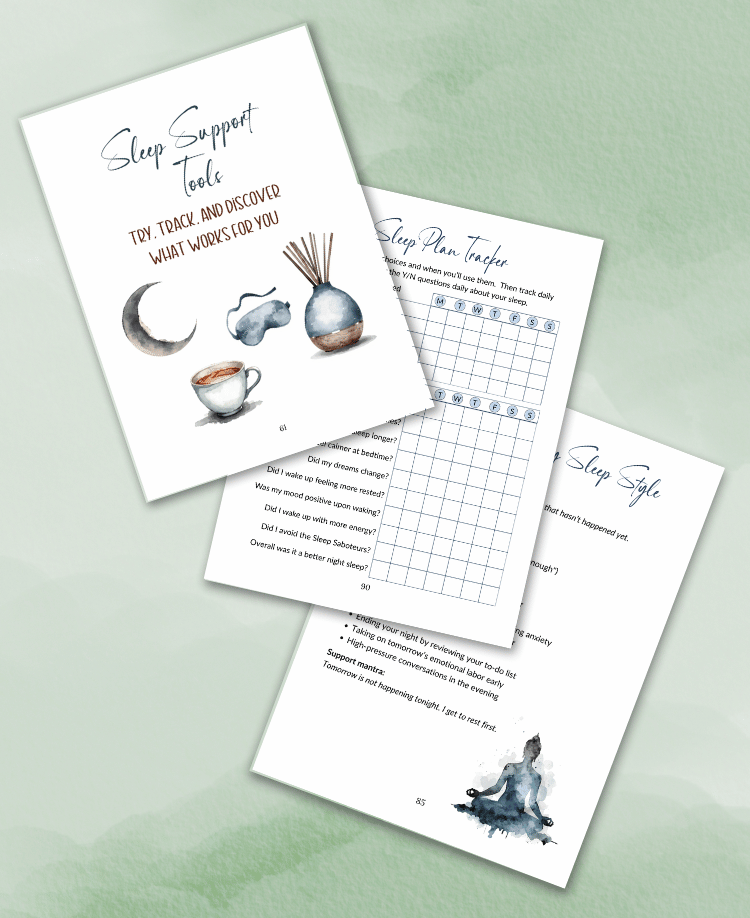
What’s Inside the Sleep & Recovery Workbook
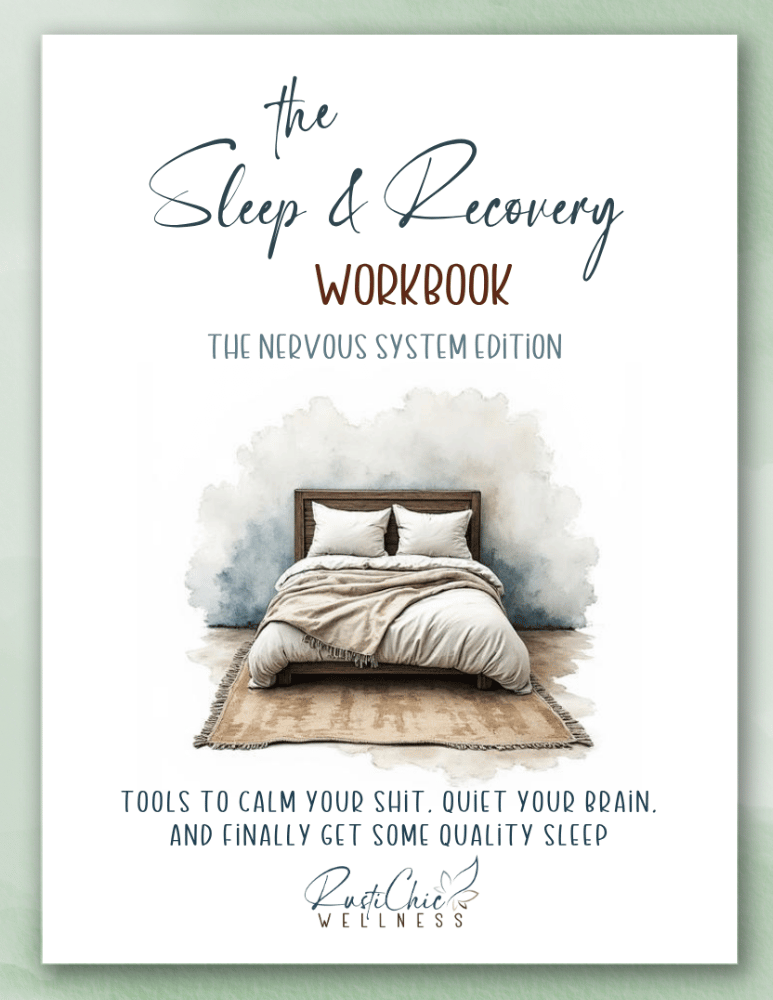
The Sleep & Recovery Workbook — subtitled The Nervous System Edition — is built on one core truth: your sleep isn’t broken. It’s responding to hormones, stress, and a nervous system that’s been asked to do too much for too long without a break.
This workbook doesn’t give you a list of sleep rules to follow. It gives you the understanding and the tools to figure out what’s actually disrupting your restorative sleep — and what to do about it.
Here’s what’s inside:
Sleep 101 — Understanding what’s actually happening The science of sleep done in plain language. Your circadian rhythm, cortisol’s role in sleep disruption, the stress-sleep doom loop, why midlife makes everything harder, and the lifestyle sleep killers most women don’t even know they’re doing — alcohol, late-night eating, screens, evening emotional processing, and the sneaky blood sugar crashes that wake you up at 2am.
Quiz: What’s Your Sleep Style? Are you an Overthinking Owl? A Temperature Tornado? A Stress Sponge? This quiz identifies your specific sleep disruption patterns so you stop throwing random shit at the wall and start addressing what’s actually going on for you.
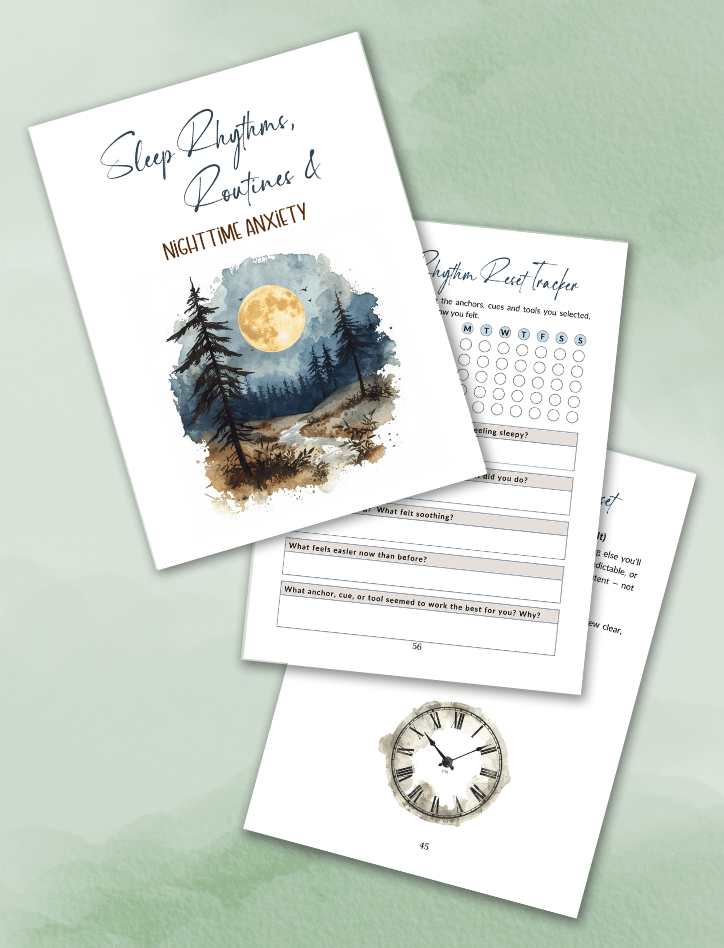
Sleep Rhythms, Routines & Nighttime Anxiety How to work with your biology instead of fighting it. Setting up your environment, building a rhythm that signals safety to your nervous system, and dealing with the nighttime anxiety that hijacks sleep for so many midlife women.
Sleep Support Tools — Try, Track, and Discover What Works for You This is the section I wish I’d had years ago. A comprehensive toolkit covering everything from weighted blankets and white noise to magnesium, ashwagandha, melatonin, cannabis, guided meditation, breathing techniques, and more — with honest information about what each one does and how to figure out what works for your system. No one-size-fits-all prescriptions. Just real tools and a way to test them to find what gets you the restorative sleep you need.
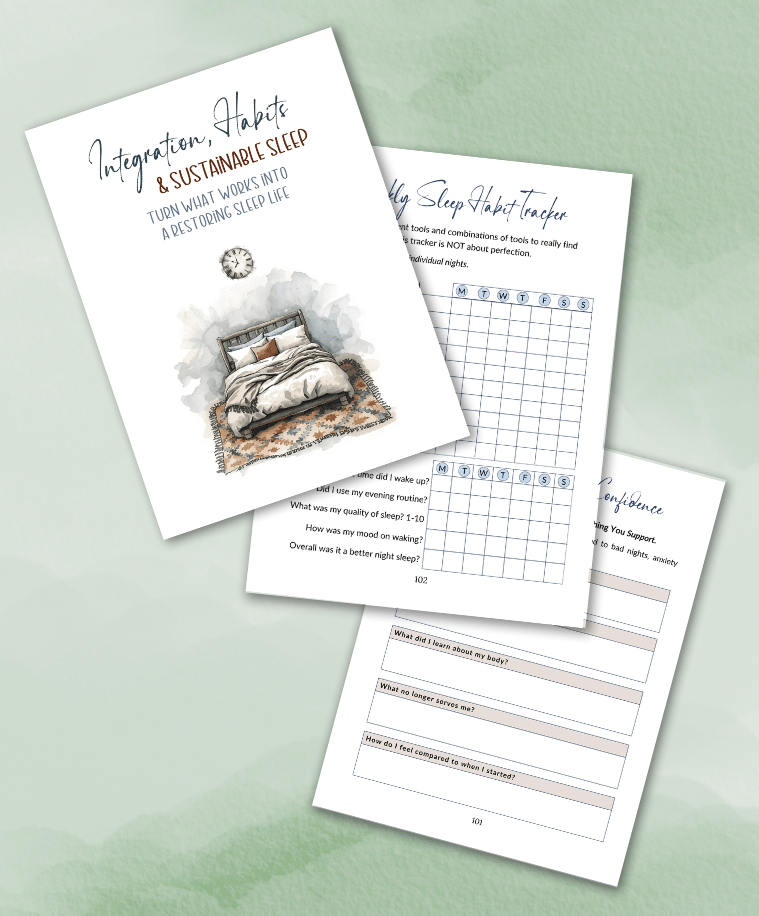
Integration, Habits, and Sustainable Sleep How to turn what works into a consistent sleep life. Building your personal sleep plan, setting boundaries to protect your sleep, preparing for the bad nights (because they’ll happen), and developing the long-term confidence that comes from knowing you have a system that works.
Tracking tools throughout — sleep habit trackers, reflection journals, a personal sleep plan builder, and a Sleep Keeper exercise to identify what you never want to give up.
This Is for You If You…
You wake up at 2am and can’t get back to sleep
You fall asleep fine but never feel rested
Your brain will not shut up at bedtime no matter what you try
You’re exhausted all day and wired at night simultaneously
You’ve tried melatonin, sleepy teas, and every other suggestion and nothing sticks
You know your sleep is shit but don’t understand why
You want to actually understand your nervous system instead of just white-knuckling your way through another bad night
Perfect sleep habits aren’t your goal. You need your sleep habits — the ones that work for your biology, your life, and your real routine. And give you the restorative sleep you need now, more than ever.
Explore the Full Workbook Library
Not sure where to start? Download the free Midlife Pivot Towards Wellness guide first — it gives you the foundation before you go deep on any single area.
Instant digital download. Use it at your own pace. Return to it whenever you need a reset.
RustiChic Wellness | theRustiChic.com | @rustichicwellness This workbook is for personal guidance and wellness support — it’s not a substitute for professional medical advice.
