Movement in Midlife — Why Sitting Is Slowly Wrecking Your Body
Movement in midlife isn’t optional — it’s the difference between aging well and feeling like your body is slowly falling apart.
Sitting is the new smoking. Use it or lose it. However you want to say it, it’s the absolute fucking truth. If you don’t move your body consistently, it will age faster than it should — and you’ll feel every bit of it.
I know because I’ve been on both sides of this. Multiple times.

The Cycles I’m Not Proud Of
I want to be honest about something before we get into what works: there have been numerous stretches in my life — including when I was deep in my couch-potato era — where I did absolutely no meaningful movement what-so-ever. No workouts, no walks, no yoga, no stretching. Nothing.
It drove me crazy. I wasn’t happy about it. But life happens. Too much going on, the middle of winter, the family is sick, the business needs attention — and once you fall out of the daily habit, getting back into it is genuinely hard. At least it is for me.
And at the end of each of those sedentary cycles, I remember exactly how it felt. Waking up in the morning was so much harder. I had achy joints. My feet hurt the moment they hit the floor. My pelvic floor was dysfunctional. I was getting constant leg cramps at night. I was hungry all the time and my core felt weak and unstable.
Every. Single. Time.
And every single time I got back into my rhythm of moving — even without major workouts, even without the gym — I was amazed at how quickly I started to feel better. The improvement wasn’t subtle. It was fast and undeniable.
That contrast — feeling like an old woman when I’m sedentary, feeling like myself when I move — is what keeps movement as a non-negotiable in my life now. Not willpower. Not motivation. Just knowing exactly what happens to my body when I stop.

What My Movement Actually Looks Like (It’s Not What You Think)
Here’s what I know for sure about me… I am so fucking over the gym.
Like many of us, I spent years believing that “real” exercise meant getting dressed, driving somewhere, doing an intense workout, driving home, and somehow fitting that into an already packed day. I don’t believe that anymore. And the research backs me up.
My daily movement is 30 minutes, first thing in the morning. Stationary bike with stretches. Or yoga and abs. Or a brisk walk with arm weights. Whatever I feel like doing that day — the variety is actually part of what keeps it sustainable. The only non-negotiable is that I do something. Every day. Full stop.
I also have poor circulation in my legs — just lucky that way — and getting daily movement in midlife has improved my circulation substantially. My joints don’t ache anymore. Getting up in the morning doesn’t feel like an act of will. My energy is better. The leg cramps that used to wake me up at night have dramatically reduced.
Beyond the dedicated morning session, I incorporate movement into my actual life wherever I can. Take the stairs. Park further away and get a brisk walk in. Take outdoor walks — this is also when I do my best business thinking, which means movement and planning happen simultaneously, which my efficiency-obsessed brain loves deeply.
I also do isometric leg exercises in bed — either first thing in the morning before I get up, or while I’m watching TV at night. Low effort, no equipment, surprisingly effective for circulation and reducing those night cramps.
And because I’m currently spending a significant amount of time sitting at a computer building this business — which is unavoidable right now — I make myself get up every hour and move for at least five minutes. Stretch, walk around, do some leg swings. Five minutes every hour adds up fast and keeps your muscles from deciding they’re no longer necessary. On the days when I’ve been sitting all afternoon, I’ll do a second movement session — yoga or deep stretching — before the evening. I won’t be in this sitting-heavy phase forever. But while I am, I’m not going to let it quietly wreck my body.
The Morning Movement Reframe That Changed Everything
Here’s the thing about morning exercise that nobody tells you: if you approach it as a workout you have to do, it’s going to feel like a chore. And you’ll find every reason not to do it.
What changed for me was shifting what I focused on entirely.
I don’t think of it as exercise anymore. I think of it as the one time in my day that’s just mine. The living room is quiet. Nobody needs anything from me yet. I can watch the news while I move, or listen to music, or let my mind wander through whatever I’m working on in the business. It’s 30 minutes of me-time disguised as exercise — and when I frame it that way, I actually look forward to it.
If you’ve been struggling to make movement in midlife stick, try this before you try anything else: stop focusing on the movement part and start focusing on what else you’re getting during that time. The exercise is the bonus. The me-time is the thing you’re actually protecting.
The Pelvic Floor Thing Nobody Taught Us

I have to talk about this because it changed my life and nobody is discussing it clearly enough.
For years I had pelvic floor dysfunction. I assumed it was just what happened after having kids and getting older. And like most women, I’d been vaguely told to “do Kegels” without much more context than that.
What I actually learned — and this is the kind of thing that makes you want to call up every woman you know — is that how you breathe during physical effort directly affects your pelvic floor. Most of us are doing it completely wrong, and it’s making things worse.
The simple version: when you exhale during exertion — like when you stand up from a chair — you naturally engage your deep core and pelvic floor in a coordinated, functional way. When you hold your breath or inhale during effort, you work against that system.
Learning to exhale as I stand up is now completely automatic. I don’t think about it. And combined with my daily movement practice, it has made my pelvic floor significantly stronger — without doing a thousand Kegels!
If you deal with any degree of pelvic floor issues — leaking, heaviness, instability — please know it is not just what happens with age. It responds to breath coordination, posture, core engagement, and movement patterns. The workbook covers this in detail because it’s too important to leave out. Movement in midlife is so critical!
Why Midlife Is Actually the Most Important Time to Move
Here’s the biology that makes movement in midlife non-negotiable — not because it’s a nice idea, but because of what’s actually happening in your body.
Muscle mass declines if you don’t fight for it. There’s a process called sarcopenia — gradual, quiet muscle loss that happens when you’re not consistently asking your muscles to work. You don’t notice it dramatically at first. You just notice that carrying groceries feels heavier, getting up off the floor feels awkward, recovery takes longer. By the time it’s obvious, significant decline has already happened. The antidote is resistance training — which does not require a gym or heavy weights. Your bodyweight, resistance bands, even water jugs count.
Bone density responds to load. Bone is living tissue. It stays strong when you regularly signal it to — through weight-bearing movement, resistance training, walking, climbing stairs. Without those signals, density decreases. With declining estrogen in perimenopause and menopause already threatening bone density, this is not the time to be sedentary. I learned this firsthand when my bone density test revealed osteoporosis on top of my cancer diagnosis (WTF?) Movement is bone medicine.
Your joints need movement to stay lubricated. Joints rely on movement to circulate synovial fluid — the lubrication that keeps them moving smoothly. When you’re sedentary, that fluid doesn’t circulate efficiently and stiffness increases. That “creaky” morning feeling most women blame on aging? Often a movement and circulation problem. NOT permanent decline.
Balance is neurological and trainable. Balance declines when it isn’t challenged — and declining balance is one of the greatest risks to independence in later life. A fall at seventy isn’t just an inconvenience. It can be a life-altering event. But balance doesn’t just decline inevitably with age. It responds to training at any age. Challenge it and it improves. Ignore it and it doesn’t.
Strength training is hormone medicine. This is the one most midlife women are still missing. Cardio has its place, but strength training specifically — building and maintaining muscle — improves insulin sensitivity, supports bone density, boosts testosterone (yes, women need testosterone too), lowers cortisol when done properly, and improves mood and confidence. If you are doing only cardio and no resistance work, this is the single most impactful change you could make.
The healthcare system is not going to tell you this. There’s no commercial incentive to help midlife women build strength and prevent decline when decline is billable. So we have to figure it out ourselves — and start before we need to.
What’s Inside the Movement, Mobility & Strength Workbook
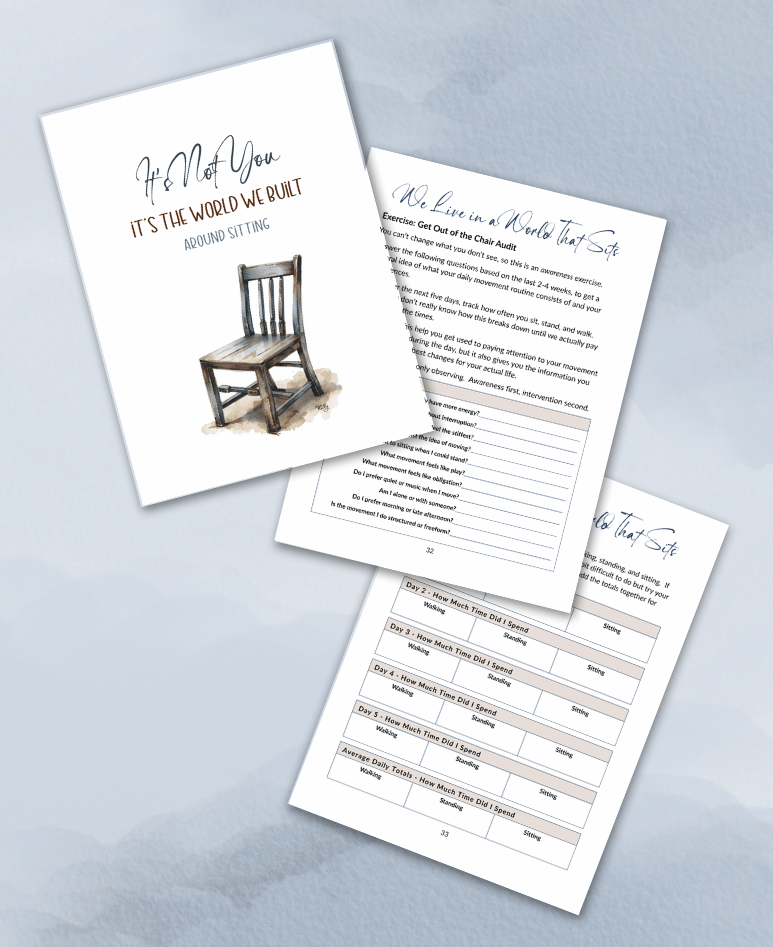
The Movement, Mobility & Strength Workbook: Because Aging Isn’t the Problem, Sitting Still Is — is not a workout manual. It’s a movement reset designed for midlife women who want strength, stability, and independence — not another program to follow blindly or feel guilty about abandoning.
Here’s what’s inside:
The Biology of Midlife Movement What actually happens to muscle, bone, joints, fascia, and your nervous system when you stop moving — explained clearly without shame or scare tactics. Understanding the biology is what makes the behavior change stick.
We Live in a World That Sits Why the modern environment is specifically hostile to movement, why “just work out harder” doesn’t fix twelve hours of sitting, and how to think about movement differently than the fitness industry has taught you.
Your Movement Audit A Get Out of the Chair Audit, movement stacking opportunities assessment, and sitting pattern analysis that show you exactly where you are right now — without judgment.
Rebuild the Foundation — Strength, Stability, and Real-Life Movement Five-minute mobility resets, daily stability checks, the pelvic floor and breath connection explained properly, balance training, functional strength exercises, and how to build a personal movement rhythm that fits your actual life.
Targeted Support Sessions 15-minute hip mobility reset, core stability session, glute activation session, and posture reset. Structured, doable, and genuinely effective without requiring a gym or any equipment.
Joyful Movement — The Part Most Fitness Content Skips A 3-day joyful movement experiment to help you discover what kinds of movement you actually enjoy — because movement you hate is movement you won’t sustain.
The 30-Day Movement Challenge Not intense. Not punishing. Just 30 days of intentional, consistent movement to build the rhythm that becomes habit.
Trackers, Planners, and Reflection Tools Movement awareness tracker, movement rhythm planner, mobility reset tracker, energy and recovery tracker, and reflection journals that help you connect your movement to how you actually feel — which is the feedback loop that makes everything stick.
This Is for You If…
You feel stiff, achy, or “old” when you get up in the morning
You’ve fallen out of any midlife movement habit and can’t seem to get back to it
You’re sitting too much and know it’s affecting you but don’t know what to do about it
You deal with pelvic floor issues and didn’t know movement could help
You’ve avoided the gym for years and need something that actually fits your real life
You want to stay strong, stable, and independent — not just now but in twenty years
You want to understand what’s happening in your body so you’re motivated from knowledge, not guilt
Your body was built to move. Modern life removed most of that movement. This workbook helps you build it back — in a way that actually works for where you are right now.
Explore the Full Workbook Library
Not sure where to start? Download the free Midlife Pivot Towards Wellness guide first — it gives you the foundation before you go deep on any single area.
Instant digital download. Use it at your own pace. Return to it whenever you need a reset.
RustiChic Wellness | theRustiChic.com | @rustichicwellness This workbook is for personal guidance and wellness support — it’s not a substitute for professional medical advice.
