Perimenopause Nearly Broke Me — Here’s What I Learned Fighting It and Cancer at the Same Time
Perimenopause hormones blindsided me — and then cancer treatment made sure I couldn’t ignore them for a single second longer.
I thought I’d dodged a bullet. At 51, when my previously light, regular periods suddenly became irregular, brutally heavy, and crampy — like my teenage years decided to come back for revenge — my doctor recommended an IUD. I got it. And almost immediately, every symptom disappeared. (Cue the angels singing…)
I had six years of bliss. No perimenopause symptoms. Nothing.
And then I had to have it removed — right before my double mastectomy and cancer treatment. And that bitch menopause made up for every single year of lost time all at once!
When Menopause and Cancer Treatment Hit Simultaneously
Here’s what I learned that nobody talks about enough: cancer treatment can throw you into medical menopause overnight.
The hot flashes, the emotional rollercoaster, the anxiety, the brain fog, the completely obliterated sleep — they all arrived at the same time, like they’d been planning a party and were pissed they’d been kept waiting. And here’s the fun part: I had no idea what was a menopause symptom, what was a chemo or radiation reaction, and what was both happening at once. It was impossible to separate.
I was dealing with a diagnosis that could kill me, a body that felt completely foreign, my family (with two teenagers and an elderly father) depending on me, and hormones that had gone completely off the rails. The overwhelm was indescribable.
I did what I had to do — followed every instruction from my surgeons and oncologists, took everything I was given, and kept going. Meditation and deep breathing, which I’d been doing for years before the cancer and which had always kept me calm, became absolute lifelines during treatment. When the anxiety really hit — and it hit hard, in a way I’d never experienced before — I leaned into those practices with everything I had. They helped me more than I can express.
And slowly, as I was able to do more research, I started tackling each hormone issue one at a time. Some were easier than others. Hot flashes eventually cooled down. Sleep improved as I built my routine. The emotional volatility became more manageable as I learned to recognize my triggers.
But here’s the thing — it’s not perfectly solved now. Nor will it ever be, because it’s an on-going process. Complete with good days and bad.
What Managing Perimenopause Hormones Actually Looks Like
I still get occasional minor hot flashes. They’re infrequent and don’t last long — nothing like the full-body inferno of treatment — but they’re there.
I deal with brain fog and decision fatigue daily. In my case I think that has more to do with the insane amount I’m trying to juggle building a business while managing everything else in my life than purely hormones. But whether it’s hormones or overload, the result is the same: when I find myself working 12 hours straight — which happens easily when you’re a solopreneur trying to get something off the ground — everything starts to suffer.
And here’s my most reliable hormone warning signal: I know I need to step back and calm my nervous system when I find myself on the verge of tears for something completely ridiculous. Like a commercial on the radio in the car. A fucking radio commercial! If I’m about to cry over that, my body is telling me something. And I’ve learned to listen before things escalate to full psychotic episode territory. Because nobody wants that to happen.
The irritability is the other one. When I feel irritable for no particular reason I can identify, that’s my cue. Something needs to shift — I need to stop, breathe, do something that helps me reset. I’ve gotten good at catching it early. Most of the time.
Learning to know your body — truly know it, so that when it’s trying to tell you something you actually understand what it’s saying — is one of the most valuable things I’ve built through this whole process. More than any supplement, any routine, any tool. The awareness comes first. Everything else follows.
The Twist I Didn’t See Coming: Osteoporosis and Tamoxifen
Before my oncologist could prescribe post-treatment hormone therapy, I had to take a bone density test.
Not only did I have stage 3 cancer. I also had osteoporosis.
So I was put on Tamoxifen — a selective estrogen receptor modulator that blocks estrogen’s effects on cancer cells. It’s a hormone therapy, but not the kind that replaces hormones. It specifically targets the estrogen receptors that feed certain types of breast cancer.
Many women can’t tolerate Tamoxifen. The side effects can be rough. I’m lucky — I don’t have intolerable side effects, and it’s become part of my daily routine. But it’s a reality of my hormone picture that I’ll be managing for years, and it’s a reminder that hormones aren’t just about comfort and perimenopause symptoms. For some of us, they’re also about cancer prevention.
The lesson here isn’t about Tamoxifen specifically. It’s about how deeply interconnected everything is. Hormones affect bone density. Cancer treatment affects hormones. Hormones affect sleep, mood, metabolism, brain function, and immune response. It can be tricky to figure out because it’s overwhelming to try and fix everything at once, yet you can’t just address one piece in isolation either — and that’s exactly why this workbook exists.
What’s Actually Happening to Your Hormones (And Why Nobody Warned You)
Most women arrive at perimenopause completely blindsided. And that’s not an accident — we were never taught this.
Here’s what’s actually going on in your body.
Your perimenopause hormones don’t decline smoothly — they sputter. Estrogen and progesterone don’t just gradually decrease in a neat, predictable way. They fluctuate wildly. Some months estrogen spikes higher than it was in your 20s. Other months it crashes. Progesterone often drops years before estrogen does. This is why symptoms feel so random and unpredictable. You’re not imagining it and you’re not being dramatic. Your perimenopause hormones are genuinely all over the place.
Progesterone drops first — and it takes your sleep and your calm with it. Progesterone has a calming, sedative effect on the brain. It supports the GABA neurotransmitter system that helps you feel grounded and emotionally resilient. When progesterone drops — which often happens in your late 30s or early 40s, before your periods even change — sleep quality suffers, anxiety creeps in, and emotional reactivity spikes. This is why perimenopause symptoms can start way earlier than most women expect.
Estrogen affects your mood chemistry directly. Estrogen supports serotonin production — your “feel good” neurotransmitter. When estrogen fluctuates, serotonin fluctuates too. This is why your mood can swing from fine to tearful to rageful within the same day. It is not a personality flaw. It is biochemistry.
Cortisol amplifies everything. Chronic stress keeps cortisol elevated, and elevated cortisol makes every perimenopause symptom worse. It disrupts sleep, destabilizes blood sugar, increases emotional reactivity, and creates a vicious loop that’s very hard to break without addressing the nervous system directly.
Midlife women carry a stress load that men simply don’t. Work, family, aging parents, everyone’s emotional needs on top of your own — your nervous system is managing all of it, all day, without a break. And then bedtime arrives and your brain finally has a quiet moment, which it immediately uses to process everything it didn’t have time to deal with during the day. This is why you wake up at 3am. And why your brain won’t shut up at bedtime. This is physiology, not weakness.
The Lifestyle-Hormone Connection Nobody Talks About Enough
Here’s what I learned that genuinely changed how I approach my hormone health every single day:
Your lifestyle choices are not separate from your hormone health. They are perimenopause hormone medicine!
Sleep is the foundation everything else is built on. When you’re not sleeping well, cortisol stays elevated, blood sugar becomes unstable, mood swings worsen, cravings spike, and your body’s ability to regulate estrogen and progesterone degrades further. Poor sleep makes every perimenopause symptom worse, period. This is why fixing your sleep is almost always the most impactful first move.
Strength training is not optional in midlife — it’s hormone medicine. Building and maintaining muscle mass directly supports metabolic function, insulin sensitivity, and bone density. All of which are under threat during the hormone changes of perimenopause. If you’re not doing some form of strength training, this is the single most impactful physical change you can make.
Blood sugar stability changes everything. Blood sugar spikes and crashes drive cortisol spikes, mood instability, fatigue, and cravings. Eating in a way that keeps blood sugar stable — real food, adequate protein, not skipping meals, not eating sugar on an empty stomach — is one of the most direct ways to support hormone balance without a prescription.
Stress management is not a nice-to-have. It is non-negotiable. Chronic stress is the accelerant that makes every hormone imbalance worse. Finding what genuinely calms your nervous system — and doing it consistently, not just when you’re in crisis — is foundational. For me it’s meditation and deep breathing, which I’d been doing before the cancer and then they became absolute lifelines during treatment. What it is for you matters less than doing it regularly.
What’s Inside the Hormones & Midlife Workbook
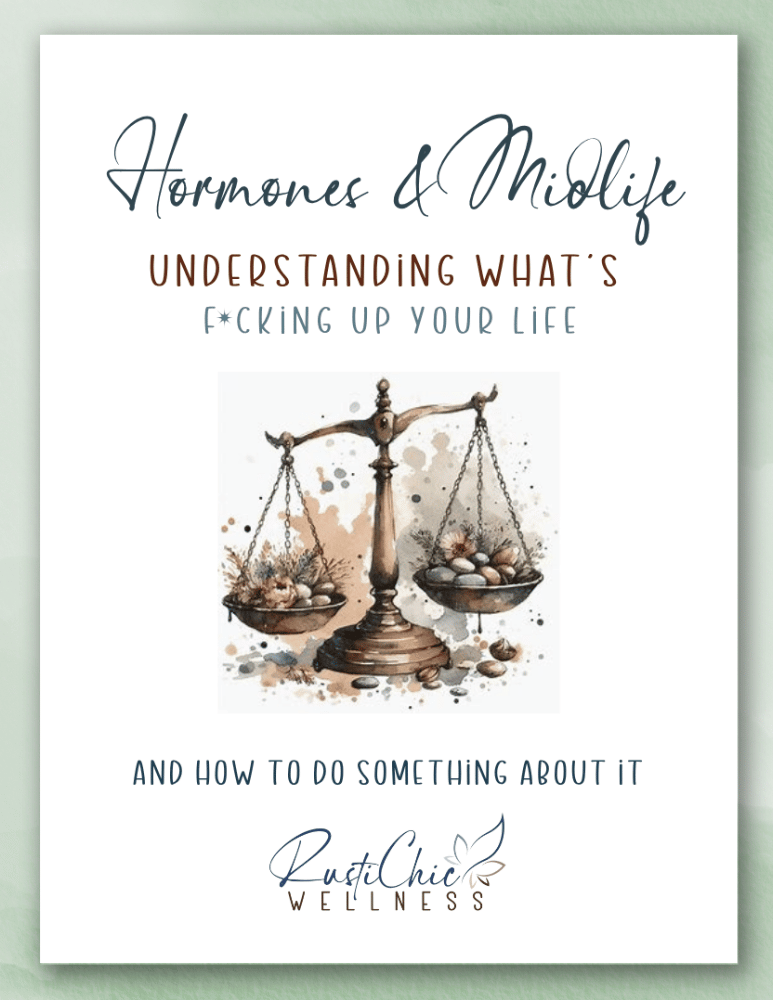
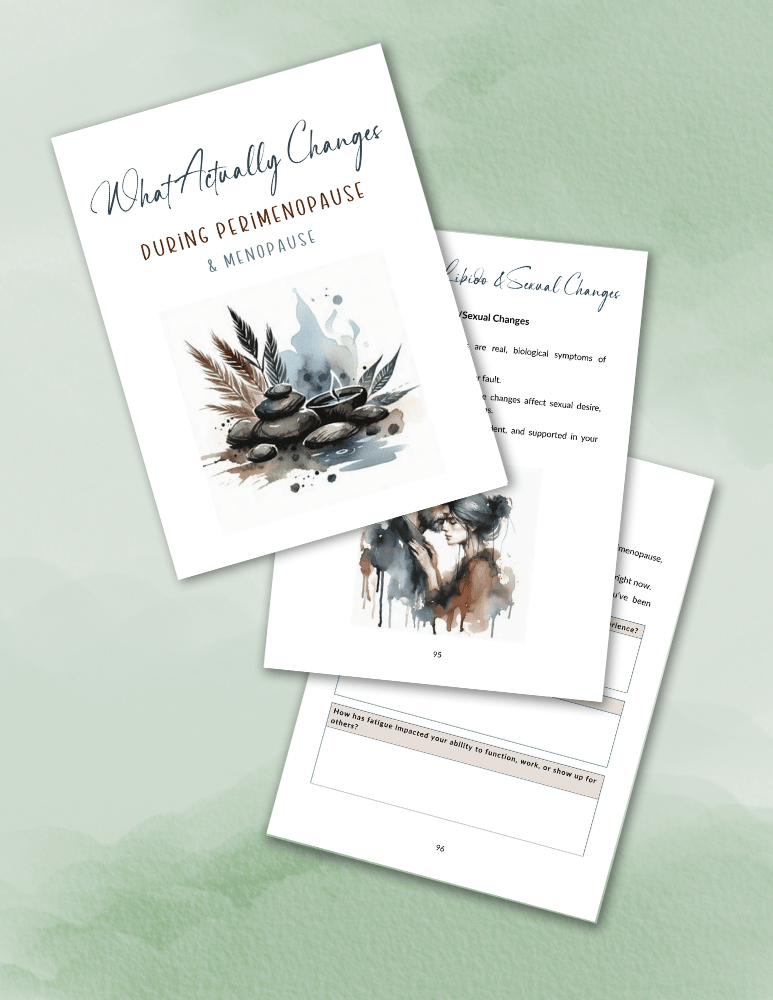
The Hormones & Midlife Workbook — Understanding What’s F*cking Up Your Life and How to Do Something About It — is the most comprehensive resource in the RustiChic lineup, because hormones touch everything.
This is not a quick read. It’s a guided journey through understanding your own hormone picture and building a realistic plan to support it.
Here’s what’s inside:
Midlife Isn’t a Personal Failure — It’s a Biological Shift The foundational reframe. Why your body isn’t betraying you, what’s actually happening hormonally in perimenopause, and the myth-busting that makes the rest of the workbook actually land.
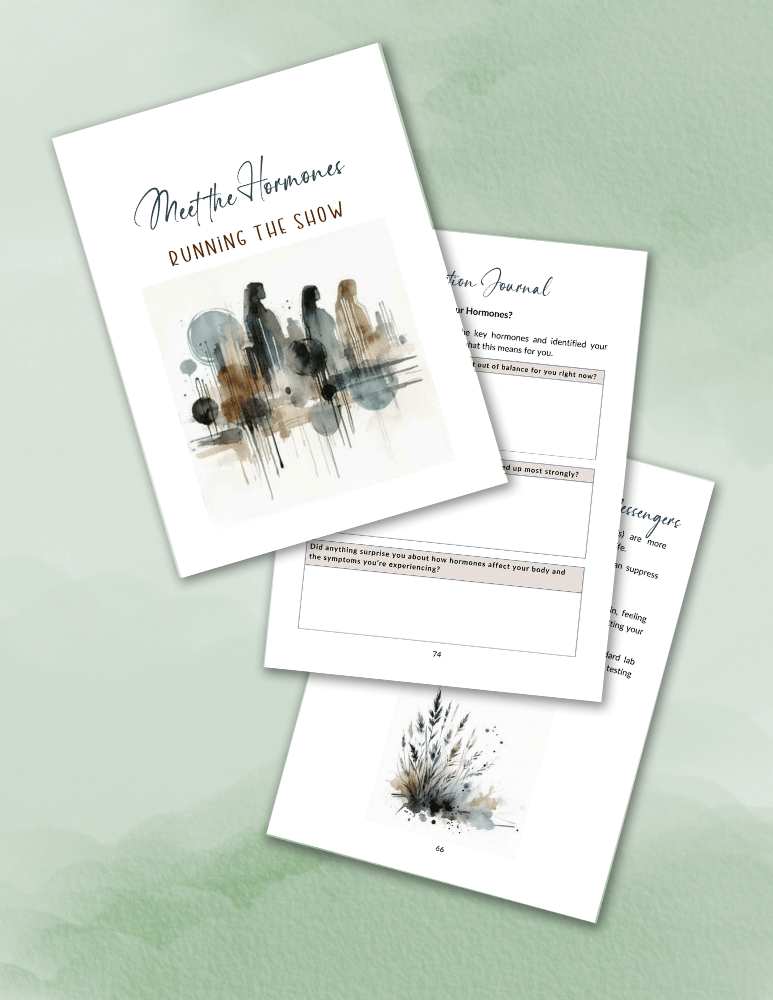
Meet the Hormones Running the Show Estrogen, progesterone, testosterone, cortisol, insulin, thyroid — what each one does, how they interact, and how midlife changes affect all of them. Plus, a quiz to identify your dominant hormone pattern so you’re not guessing.
Perimenopause Is Not Predictable Why your symptoms feel random, what’s driving the fluctuations, and why the unpredictability is actually explainable once you understand what’s happening. Covers mood, sleep, fatigue, weight, libido, and brain fog — all the things nobody warned you about.
The Lifestyle-Hormone Connection Sleep, strength training, blood sugar stability, stress management, and environmental hormone disruptors — how each one directly affects your hormones and what to actually do about it.
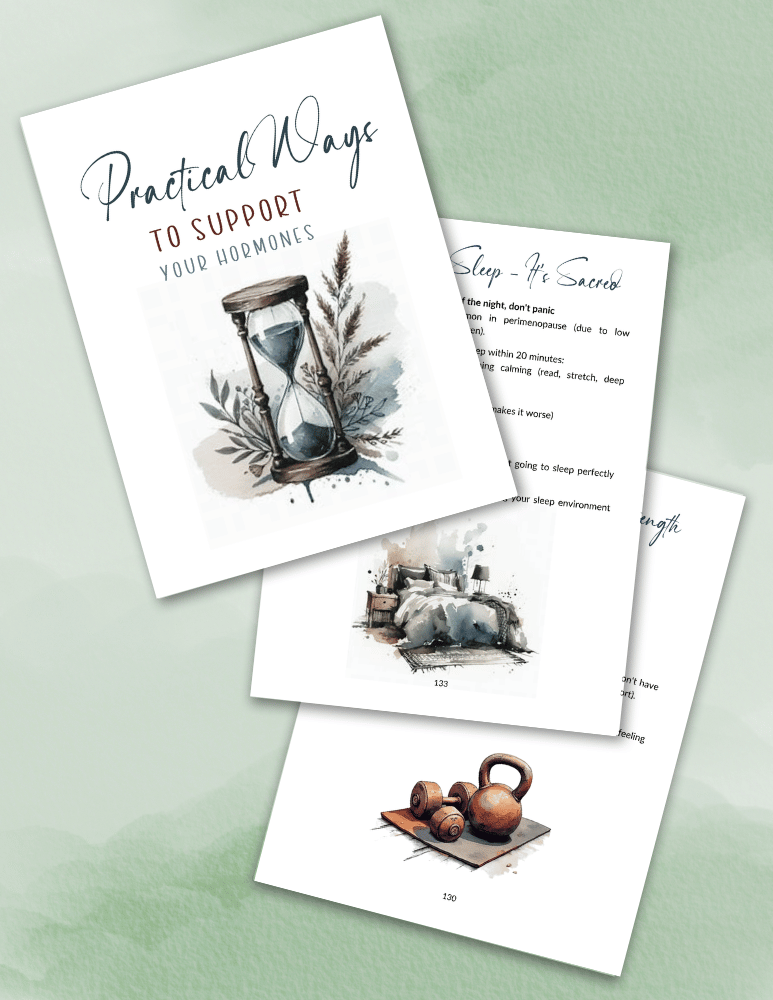
Practical Ways to Support Your Hormones Concrete strategies for eating to stabilize blood sugar, supporting perimenopause hormones with movement, protecting your sleep, lowering your stress load, and reducing environmental disruptors. Real actions, not vague advice.
When to Talk to Your Doctor What’s normal vs. what’s not, questions to ask your doctor, understanding hormone testing, and an honest look at HRT and when it makes sense to consider it.
Your Hormone Story Connecting all the dots into your personal hormone picture. Building your hormone support plan with trackers, a hormone-friendly day builder, and a commitment to yourself that actually sticks.
This Is for You If You…
You’re in your 30s, 40s, or 50s and something feels off but you can’t explain it
Your periods have changed and you don’t know what’s normal
You’re dealing with mood swings, brain fog, sleep disruption, weight changes, or anxiety that came out of nowhere
You’ve been told your labs are “normal” but you feel anything but
You want to actually understand what’s happening in your body instead of just managing symptoms
You’re navigating hormone health alongside another health challenge — cancer treatment, autoimmune conditions, chronic illness
You’re done being blindsided by your own body
Every woman goes through this transition. Almost none of us were prepared for it. This workbook changes that.
Explore the Full Workbook Library
Not sure where to start? Download the free Midlife Pivot Towards Wellness guide first — it gives you the foundation before you go deep on any single area.
Instant digital download. Use it at your own pace. Return to it whenever you need a reset.
RustiChic Wellness | theRustiChic.com | @rustichicwellness This workbook is for personal guidance and wellness support — it’s not a substitute for professional medical advice.
